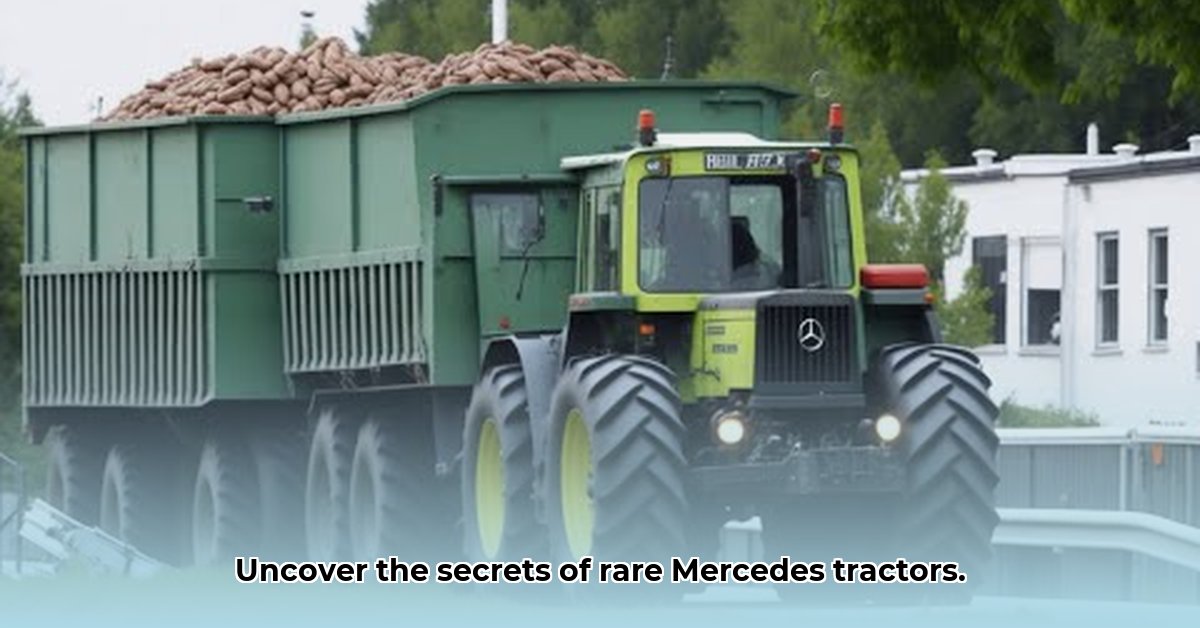
The Unexpected Legacy of Mercedes-Benz in Agriculture
Mercedes-Benz: a name synonymous with luxury automobiles. Yet, tucked away in the annals of automotive history lies a less-known chapter: the company's foray into agricultural machinery, specifically the innovative MB Trac series. This article delves into the fascinating history, unique engineering, and ultimate demise of these rare and highly collectible tractors, exploring the lessons learned from their rise and fall. We will also explore the enduring impact of their design philosophy on modern sustainable agricultural practices. For more tractor history, check out Case Tractor history.
Daimler, Benz, and the Dawn of Tractor Innovation
Long before the iconic three-pointed star graced the hoods of luxury cars, both Daimler and Benz independently explored the potential of mechanized farming. Benz, notably, produced the world's first commercially available diesel tractor in 1922 – a remarkable achievement at the time. However, it was the post-war merger of Daimler-Benz that truly ignited the company's tractor ambitions. This culminated in the development of the revolutionary MB Trac series.
The MB Trac: Engineering a Revolution in Agricultural Machinery
The MB Trac wasn't just another tractor; it was a paradigm shift in agricultural machinery design. Unlike the typical tractors—often modified versions of conventional vehicles—the MB Trac was built from the ground up as a uniquely engineered machine. Its integrated four-wheel drive (4WD) system delivered unparalleled traction and maneuverability, conquering challenging terrains with ease. This wasn't a bolt-on feature; it was fundamental to the tractor's design.
But the true genius lay in the MB Trac's dual three-point hitch. This ingenious system allowed farmers to attach multiple implements simultaneously, dramatically streamlining workflows and boosting efficiency. This innovation directly contributed to the advancement of more sustainable practices by reducing the number of passes needed across fields, minimizing soil compaction and fuel consumption.
Let's examine some key models to appreciate the breadth of the MB Trac series:
| Year | Model | Horsepower (hp) | Approximate Price (USD, Adjusted) | Drive Type | Notable Features |
|---|---|---|---|---|---|
| 1978 | TRAC 800 | 71.02 | ~$8,500 | 4WD | Early model, establishing the foundational design |
| 1979 | TRAC 800 | 80 | ~$18,000 | 4WD | Refined version of the initial model |
| 1980 | TRAC 800 | 73.97 | ~$10,000 | MFWD | Robust build, reliable performance |
| 1983 | TRAC 1500 | 150 | Data Unavailable | 4WD | High horsepower for intensive applications |
| 1984 | TRAC 1000 | 100 | ~$23,000 | 4WD | Increased power and capabilities |
| 2003 | TRAC 1600 | 156 | ~$82,000 | 4WD | One of the most powerful models, commanding price |
| 2011 | TRAC 1400 | 136 | Data Unavailable | 4WD | Later model, often highly sought after |
(Note: Prices are approximate and adjusted for inflation. Actual prices varied based on condition and included equipment.)
The significant price variations reflect factors such as horsepower, age, rarity, and included features. This price disparity eventually played a role in the MB Trac's market struggles.
Market Challenges and the Discontinuation of a Visionary Tractor
Despite its technological superiority, the MB Trac ceased production in 1991. Several factors contributed to this unexpected end. The sophisticated engineering, while delivering unparalleled performance, resulted in high production costs. This placed the MB Trac at a considerable price disadvantage against established competitors offering comparable (albeit less innovative) tractors. Furthermore, changing market demands and evolving farming practices may have also contributed to its diminished appeal. Ultimately, the MB Trac's tale serves as a compelling case study on how even the most innovative products can falter in the face of economic realities.
The Enduring Legacy: Innovation and Sustainability
Although its commercial run ended, the MB Trac's legacy continues. Its design, emphasizing efficiency and sustainability, remains influential. The focus on minimizing soil compaction—a significant contribution of the four-wheel drive and the dual hitch system—laid the groundwork for future advancements in sustainable farming practices. Today, the MB Trac holds a special place in the hearts of collectors and agricultural enthusiasts, its rarity and enduring engineering prowess cementing its status as a remarkable piece of agricultural history. The machine continues to inspire discussions about the delicate balance between technological innovation and market viability in the agriculture sector.
Further Reading
For more detailed information on the Mercedes-Benz MB Trac, you can explore online resources such as TractorData and TractorHouse, as well as relevant academic papers and historical archives on agricultural machinery.